World · NBC 60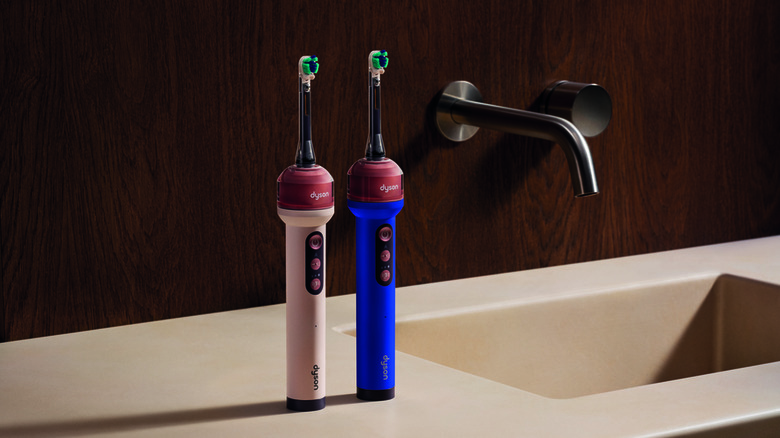
For its latest trick, Dyson is coming for your mouth. Dyson Whenever Dyson enters a new product category, it causes quite a stir. From hairdryers and styling tools to headphones and wearable air purifiers , the company has certainly applied its expertise in moving air to surprising places.
With the announcement of the Dyson CameraJet today, the vacuum maker is taking its cleaning prowess to your mouth. That name certainly doesn't make things clearer, because when you think of a camera and a jet you probably don't say: "Aha! Toothbrush." But that's precisely what the CameraJet is.
It's a super-engineered toothbrush that has a camera, water tank and motors onboard to help it combine brushing, flossing and rinsing into one device. The company's founder James Dyson said in a statement, "By combining a camera, machine learning, precision fluid dynamics, advanced brushing technologies, connectivity and Wi-Fi, Dyson CameraJet introduces an entirely new way to keep your mouth healthy." Though it seems unusual at first, after some time at a demo, I realized it's quite natural for Dyson to take on this category. After all, what is an electric, motorized toothbrush but a set of moving bristles aimed at getting dirt and debris out of tight crevices?
Dyson is certainly no stranger to that sort of machinery . If you're wondering why a camera is necessary, though, the answer is, partially, AI. How the Dyson CameraJet works Dyson The Dyson CameraJet has what the company calls a "100k pixel macro lens camera" mounted right under the head of the brush.
That's 0.1 megapixels in more typical camera terminology, which may seem like a very small number, but it's certainly supplemented by some algorithmic effort. More specifically, 16 million lines of code and "a machine learning system trained on 470,000 dental images collected during development" are behind the computer vision targeting here. Basically, all that computing has taught the CameraJet how to identify the gaps between your teeth.
When you brush and the system sees a gap, it will shoot a jet of fluid in a conical shape that helps to floss while you brush. To prevent liquid from accumulating in your mouth as you move along, these bursts of mouthrinse are fired in tiny amounts. The capacity of the water tank that surrounds the neck of the brush is just 12.5ml (0.42 fluid ounces), which is just about two and a half teaspoons.
According to Dyson, the CameraJet's "Gap Optical Targeting" system analyzes "28 live images per second to identify and target gaps between teeth in real time" and "within 100ms of the camera seeing a gap, the device detects and jets the gap." That camera isn't just there to tell the toothbrush where to shoot fluid. You can use the companion MyDyson app to get a better view of your mouth, especially the back of your teeth. The live-viewing feature is only available during live viewing or auto-jetting, and Dyson says no images are recorded or stored on the product or in the cloud.
You can also use the app to get tips, guides and personalized feedback on how to brush better, with details on where you're already good and what areas you might be falling back on. The app also offers settings so you can tweak brushing intensity and various jetting modes. In addition to the camera, the company said it uses an "anti-gravity tank with a diaphragm pump and pressure chamber that adapt during use to deliver controlled jets in any orientation." That means no matter how you hold your toothbrush, the CameraJet should be able to pump water to your mouth, even if you're somehow upside down and pointing awkwardly at the back of your teeth.
Dyson also stresses the importance of the shape of its water stream. Instead of a simple needle-shaped jet like many other water flossers, Dyson said its "fluid dynamicists spent years optimizing the profile of the jet to remove plaque more effectively." As a Singaporean, I feel inclined to mention that the company developed "its own proxy plaque through a five-year collaboration with the National University of Singapore's Faculty of Dentistry" as part of its engineering process. The result of all that work is a cone-shaped spray of fluid that Dyson says offers wider coverage to sweep and remove plaque while being propelled "at a lower pressure to be gentler on gums and enamel." As for what fluids to fill the tank with, you can choose your favorite clear mouth rinse that's SLS-free to prevent foaming.
Dyson is also making its own non-foaming toothpaste and a low-foaming mouthrinse to be used with the CameraJet, so the camera can see clearly without foam blocking its view. What about them bristles? Dyson Despite additions like vibration, negative ionization and now cameras and AI, it's fair to say that the most important part of a toothbrush is still the brush head itself.
So what's Dyson's like? The CameraJet has a dual-bristle head with a contoured surface that helps it better hug the curvature of your teeth. Dyson says it'll also clean along the gumline, as the softer outer bristles sweep along your jaw, while the slightly firmer inner bristles will target surface stains.
Each brush head has a sonic dampener to make it quieter and more comfortable, and comes with an RFID tag that not only notes when it's connected to the device, but also how many cleans you've performed. It's not meant to tell on you, but alert you when it's time to get a replacement. The company is also offering a "sensitive variant of the brush head, designed to be even gentler for those with sensitive teeth and gums." Like many other sonic toothbrushes, the CameraJet will warn you if you're applying too much pressure.
And like its counterparts, Dyson's electric toothbrush will mechanically move the bristles. The CameraJet uses "unique variable sonic oscillation," according to the company, "keeping the bristles in constant motion and helping to prevent stalling, especially in hard-to-reach areas." When it's time to refill or recharge the CameraJet, the company says it's made a docking station that can refill the tank in just three seconds. It will charge the device between uses, and a travel case is included with your purchase.
I had the chance to check out a CameraJet ahead of its launch today, and while I didn't get to brush my teeth with it, it certainly felt relatively easy to maneuver in spite of its water tank. I've been begging for a tech product to make brushing and flossing less tedious, and the CameraJet certainly seems designed to do that. It may come off a bit overengineered, but if it delivers on its promise at the end of the day, I don't mind some bells and whistles.
Sit tight for our review to see if Dyson can make my daily routine less of a chore. I'm also curious what my dentist thinks of its results. The CameraJet is available today in two colors that will be no surprise to anyone familiar with Dyson products: Ceramic Ultra Blue and Ceramic Pink.
It'll cost $499, and that includes the refill dock, charging cable, two regular brush heads and the travel case I mentioned. That's about $100 more than the Philips Sonicare Prestige 9900 and the OralB iO Series 10 rechargeable toothbrush . Dyson products typically cost more than the competition, but as I learned from my experience with its hair styling tools, they're also usually more durable.
Plus, you're also getting a built-in water flosser here, and for better or worse, an onboard camera.
Source: engadget.com